

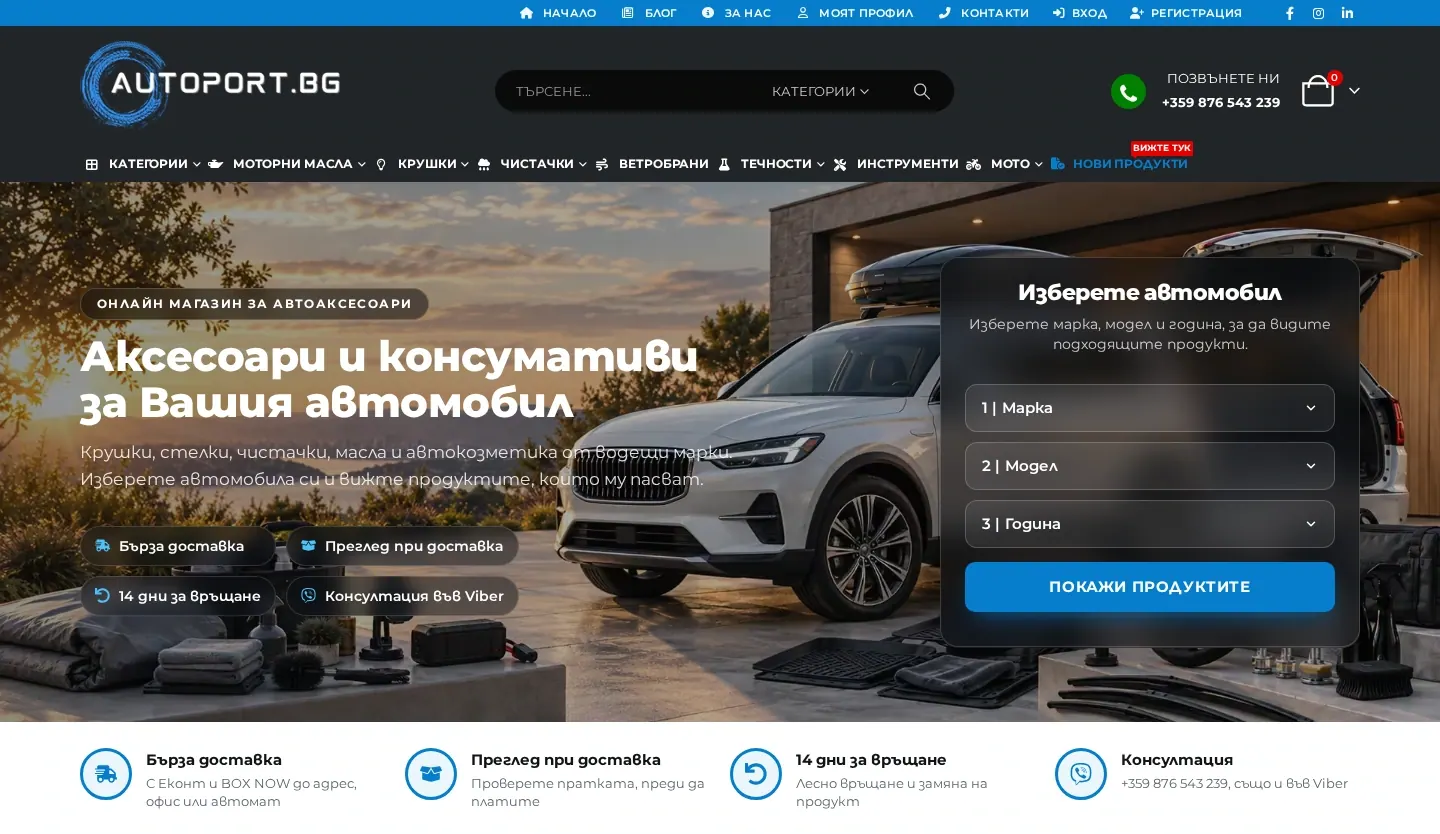
Autoport.bg
An online store for car accessories, including rubber and carpet mats, motor oils and additives, with product search by car make, model and year.
Services
A working online store is just the beginning. Next come the questions: how to accept more payment methods, how to create shipping labels without retyping, how to get products into Google Shopping and onto marketplaces, and how to measure what actually sells. E-commerce solutions at Penkov Studio answer those questions.

E-commerce Solutions
01
Card payments, cash on delivery and bank transfer, with order statuses handled correctly.
Speedy and Econt: delivery cost calculation, office or locker selection, and shipping labels created from the order.
Feeds for Google Merchant Center and other platforms, with accurate prices, stock and attributes.
Preparing product data and connecting to marketplaces when you want to sell beyond your own store.
E-commerce tracking in Google Analytics 4, covering product views, add-to-cart events and purchases.
Reviewing the path to purchase and removing the steps where customers drop off.
02
How orders are taken and processed today, where manual work creeps in and where customers are lost.
Ranking improvements by impact and effort, so you start with what delivers the most.
Setting up payments, couriers, feeds and tracking, tested on a staging environment.
Checking the full journey: order, payment, shipping label, emails and data in Analytics.
Tracking the impact of the changes in your sales data.
03
Tsvetelin Penkov works daily as E-Commerce and IT Administrator at BestAuto Bulgaria, handling products, orders and Google search.
Shipping labels and statuses without retyping addresses and phone numbers.
You see which products and channels drive sales, rather than guessing.
This service is not about creating a new online store; for that, see online store development. It is about the processes around the sale: how customers pay, how orders reach the courier, how your products show up elsewhere and how you find out what is working.
Bulgarian shoppers still often choose cash on delivery, but card payment is increasingly expected. Each method has its own settings and order statuses. A badly handled status leads to orders that look paid but are not, or the other way round. That is why payments are tested with real scenarios, including declined payments.
If every shipping label is created by hand on the courier's website, you lose time and risk a wrong address. Integrating Speedy or Econt lets customers choose an office or locker during checkout and see the real delivery cost, while you create the label in one click. The technical side of connecting to external systems is covered under API integrations.
A product feed is a file listing all your products, prices and stock, which Google Merchant Center and other platforms read automatically. Its quality is critical: a wrong price or a missing attribute can stop a product from showing. The same data is used when selling through marketplaces.
Without proper e-commerce tracking in Google Analytics 4, you cannot tell which products get viewed but not bought, or at which step customers give up. Tracking is set up to respect the cookie banner and each visitor's consent.
Tsvetelin Penkov works with an online store every day as E-Commerce and IT Administrator at BestAuto Bulgaria, and the portfolio includes stores such as autoport.bg and alpscube.com. Tell us about your store and what you want to improve through the project inquiry form.
An online store for car accessories, including rubber and carpet mats, motor oils and additives, with product search by car make, model and year.

An online store for beauty products with a bold look and a clear focus on product categories.
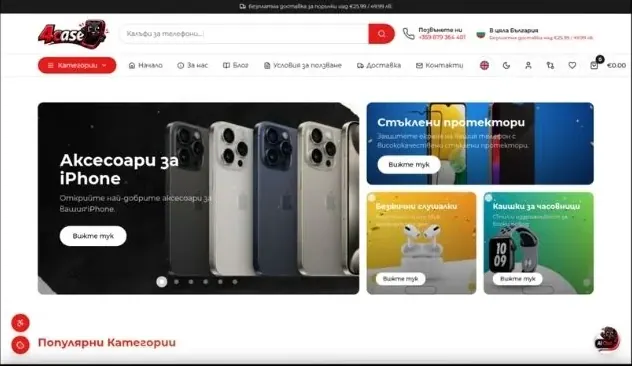
An online store for iPhone and smartphone accessories: cases, glass screen protectors and personalised products.
FAQ
Yes. The integration can cover delivery cost calculation, office or locker selection and shipping label creation. You will need a contract with the courier and access to its API.
You need an agreement with a payment provider or bank. The payment method is then integrated into the store and tested, including declined payments.
A feed is a file with your products, prices and stock that platforms such as Google Merchant Center read automatically. You need one if you want your products in Google Shopping or on other platforms.
Yes. It starts with an audit of the current store and the processes around orders.
Through e-commerce tracking in Google Analytics 4, which shows product views, add-to-cart events and purchases before and after the changes.
A business or service website built from structure to launch, with a solid technical foundation for Google.
Explore the serviceWordPress sites with Elementor, WPBakery or Divi, a child theme and custom tweaks, easy to edit without writing code.
Explore the serviceAn online store with products, categories, filters, payments, delivery and legal pages, ready for its first orders.
Explore the serviceNext step
Tell us briefly what you need. You will get an email reply with a few clarifying questions and an indicative quote.